Pay once. No subscription
You buy Pásek for a one-off price and it's yours. No monthly fees for the right to open your own house. Here's honestly why we decided this way.
Almost every app today wants a subscription. We understand why — recurring revenue is comfortable for a developer. But for a tool like Pásek it felt unfair. You measure your own house once; why should you then pay every month for the privilege of returning to that data?
How we do it
Pásek is a one-time purchase. You pay once and it's yours. All the core functionality — scanning, floor plans, measurement with tolerance, the cadastre, photo documentation, the 3D model, every export — runs offline and forever, with no further fees.
No credits, no "premium" locked features, no trial countdown. Dark mode, exporting your data, access to your own passport — that will never sit behind a paywall. That's a principle.
So what will cost money?
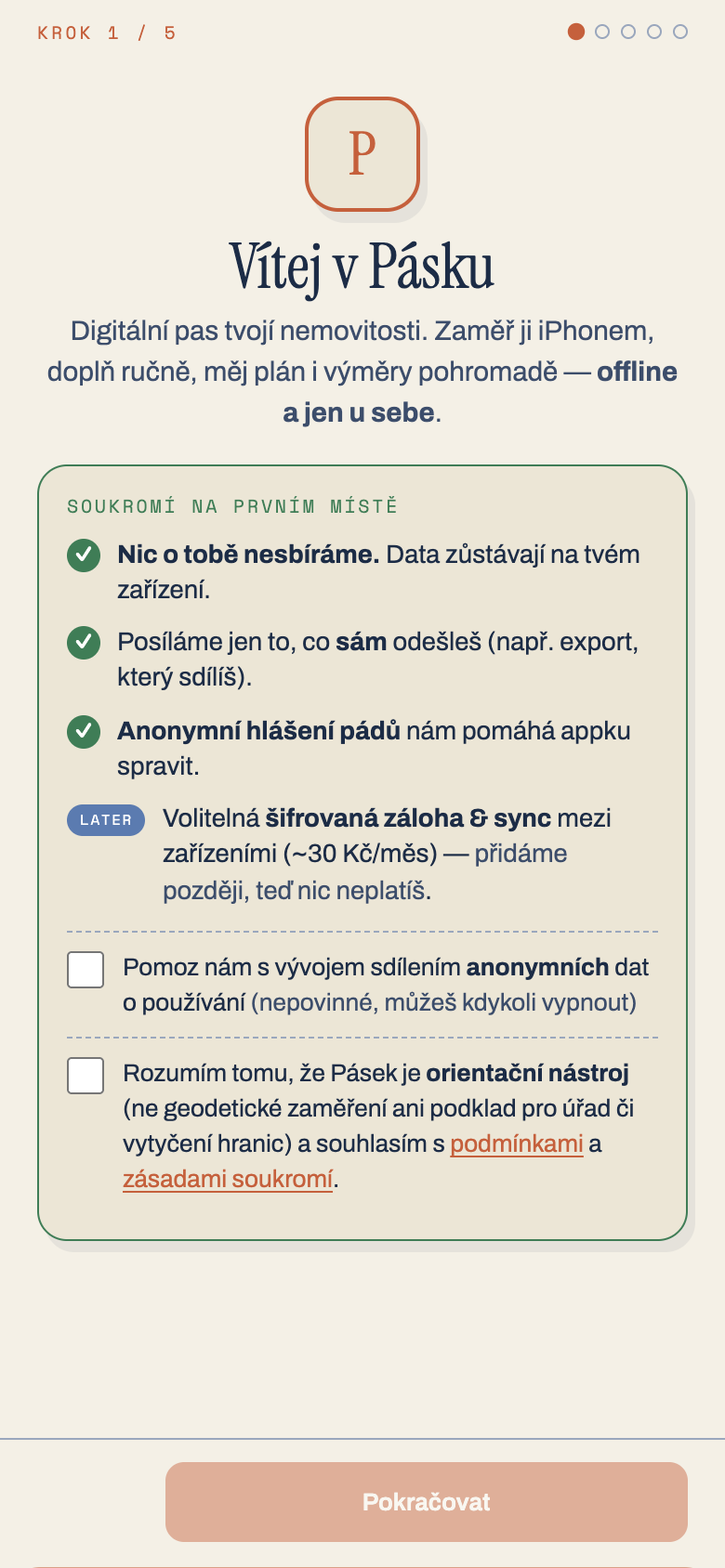
We'll be honest here too. The only paid add-on we're planning is optional sync and backup across devices — somewhere around a euro or two a month. That's a service that genuinely costs money every month (servers, transfers), so a monthly charge for it makes sense.
The key word is optional. If you don't want it, you lose nothing from the core — you still have the whole passport with you and back it up manually by exporting. And the colour themes we're considering will come to subscribers as a free bonus, not as another separate purchase.
Why this way
Apple and Google take 15–30 % of every payment. On a one-off purchase and on a monthly fee alike. That pushes us towards simplicity: one honest purchase, with a clear statement of what you get for it. No tricks to extract more from you.
Pásek's story is "pay once, have everything offline and with you". A subscription would break that story — so we don't do it.
Thanks for reading the build diary — and if you use Pásek, get in touch about anything. We're building it with you, too. Next time we return to what sets Pásek apart most: how it admits, for every measurement, just how much to trust it.