Why old houses have no right angles
Most floor-plan apps quietly straighten walls into a tidy rectangular box. Pásek deliberately doesn't — and here's why.
Try holding a set square to the corner of an old cottage. It almost never fits. A century of settling, damp, timber ceilings, plaster laid on by eye — the walls have leaned and bulged, and no corner is an honest 90 degrees. That's normal. It would be a defect if it were.
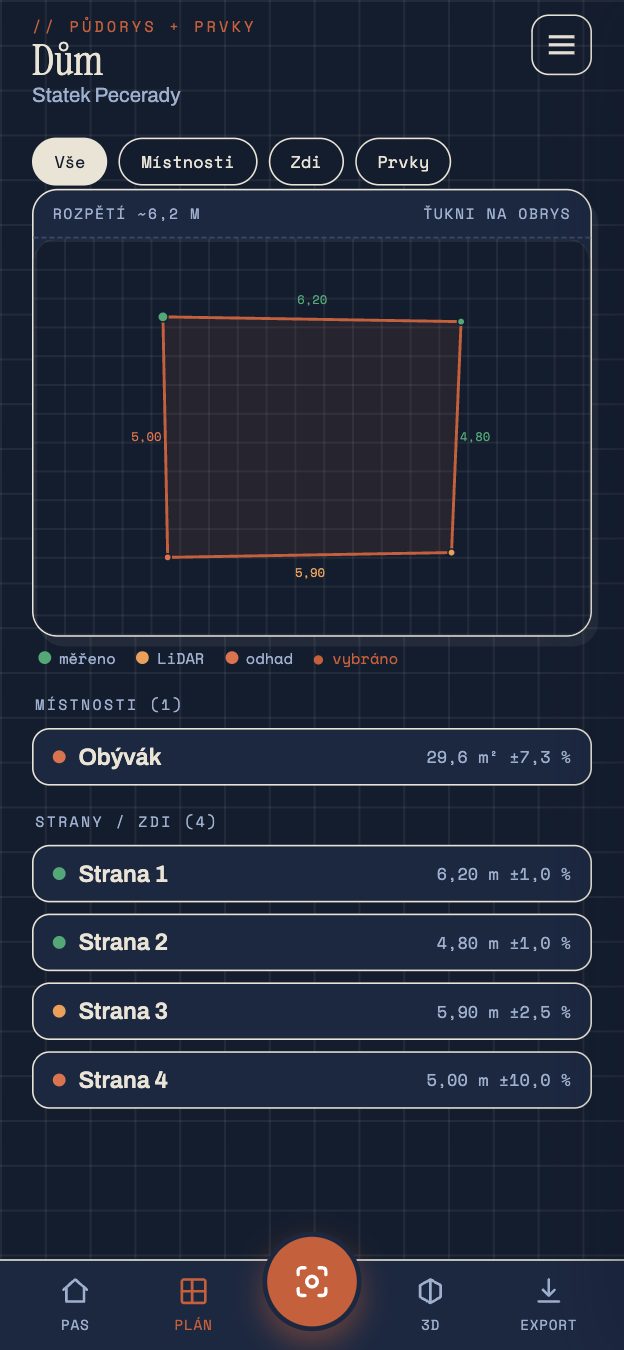
The convenient lie most apps tell
Many floor-plan tools do one thing that looks harmless: the moment they measure a corner near a right angle, they automatically snap it to exactly 90°. The result is a neat rectangular box. The plan looks clean, professional.
But it's a lie. Minor in a new build, fundamental in a two-hundred-year-old farmhouse. Straighten four corners and you shift the walls — and the area the app shows stops matching what's actually behind the door. You buy flooring against a number that came from a cosmetic tweak, not a measurement.
What Pásek does
Pásek doesn't snap angles. When a corner leans, it stays leaning. The floor plan looks exactly as crooked as your house — because that's the whole point.
- A wall that converges, converges on the plan.
- An L-shaped room stays L-shaped, not two rectangular boxes.
- The area is computed from the real outline, not an idealised one.
The same holds when you assemble rooms into a storey by hand. You can rotate a room completely freely, by any angle around its centroid — no snap to 90° that would "fix" your geometry into the wrong shape.
Why it matters
Pásek's goal isn't a pretty picture. It's a usable number — how many square metres of flooring to order, whether the wardrobe fits, what the plastering will cost. A crooked but truthful plan serves you better than a straight but invented one.
Pásek is an orientation tool. It keeps real angles as faithfully as it can, yet it doesn't replace a geodetic survey or a boundary survey.
Next time: how we assemble a whole building from individual scanned rooms.