From rooms to a whole building
Scanning one room is easy. Assembling rooms into a storey that actually lines up is the hard part. How Pásek handles it.
One room is a partial win. But a house isn't a room — it's a living room, kitchen, hallway, bedroom and bathroom that have to connect. And assembling them is the technically hardest part of the whole survey.
Why it isn't trivial
When you scan room by room, each scan lives in its own coordinate system. The phone doesn't know the kitchen is "to the left of the living room" — to it they're two independent worlds. Lining them up is a problem even Apple doesn't officially solve: relocalising between separate scans is fragile and unreliable.
Pásek takes two routes and uses each where it makes sense.
When it works in one go
Modern iPhones (on iOS 17) can continue a scan seamlessly: you walk through the door into the next room with the camera still live. Because of that the phone continuously knows where it is — and the rooms assemble into a shared space on their own. The key was keeping the camera lit between rooms; the moment it goes dark, tracking is lost and the continuation falls apart. That little detail cost us a few rewrites.
When a human hand is needed
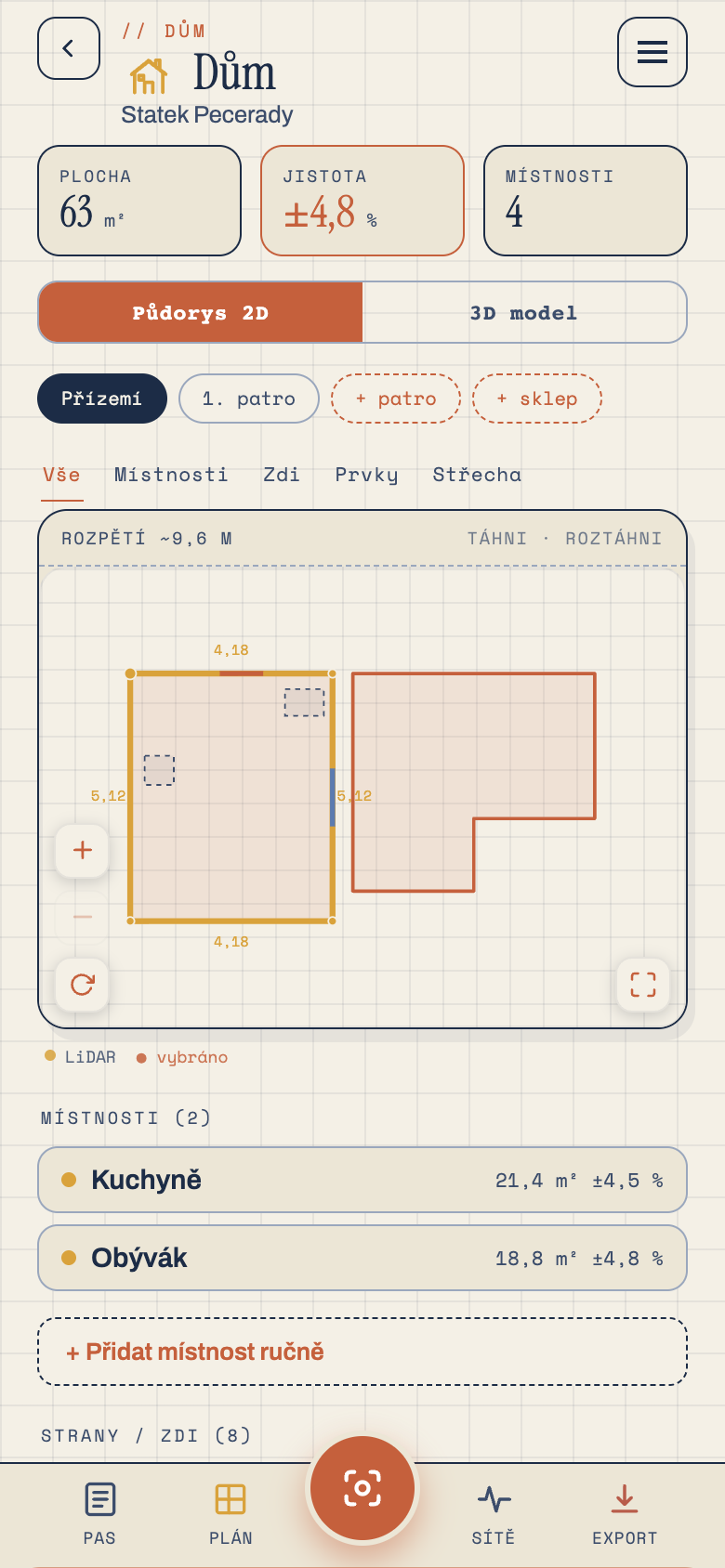
Sometimes you scan a room later — a different day, on its own. Then comes manual assembly: in the storey plan you grab the room, drag it into place and rotate it freely by its handle. No automation guessing — you know best that the bathroom is down the hall on the left.
A finished storey yields not just a 2D floor plan but a spatial model of the whole building — all rooms at once, in their correct relative positions.
Pásek is an orientation tool, not a geodetic survey.
Next time we'll look at that 3D model up close — and walk through the house in augmented reality.